REINVENTING LANDFILL CELL CONSTRUCTION WITH LECA® LWA

Skanska has been quarrying rock at Häradsudden for many years. Now, Ragn-Sells has taken over the site and is repurposing the pit to build a new hazardous waste landfill. The new use of the land places strict environmental demands on the containment system. A tailor-made solution with Leca lightweight aggregate (LWA) not only provided stability, but also reduced CO₂ emissions and increased the landfill cell’s volume.
Ragn-Sells’ new hazardous waste landfill was inaugurated in May 2024. When constructing such a facility, it is essential to protect the surrounding nature and waterways so that the waste can remain underground without impacting the environment. A dense, long-term, and sustainable solution is crucial—often achieved with concrete. But the construction now in place is entirely new, developed specifically for this project—and built without concrete.
FACTS
Project: Rock quarry converted into hazardous waste landfill
Location: Häradsudden, Norrköping
Client: Ragn-Sells
Companies involved: Structor, Firma Terra, Gnesta Bergbyggare AB
Leca product: Leca LWA 10mm/20mm
Delivery: Pneumatic blowing
Carbon Dioxide Reduction of 1,500 Tons
Blasting rock to extract stone is not done gently. The blasting leaves the rock face with loose blocks, sharp edges, and irregular surfaces. Before construction began, Rikard Gothäll from Firma Terra was brought in to assess the safety of the rock wall.
“We came in to ensure that the rock face was safe to work next to. I asked Ragn-Sells what they planned to build, and they said a concrete wall around the landfill. That sounded expensive. So, we started exploring alternatives to eliminate the need for concrete,” says Rikard.
Hazardous waste in a landfill must be enclosed in a thick membrane, in this case a rubber liner. If the liner rests directly against the jagged rock, it risks tearing. Concrete was initially considered to create a smooth layer between the rock and the liner. But Rikard’s knowledge of lightweight aggregate opened another possibility.
“I had used lightweight aggregate before to fill around buildings, so I knew the material well. Here, there was no building to fill against, which was a new challenge. But thanks to great collaboration, we developed a solution where we could remove the concrete entirely and instead use LWA as fill against the rock.”
The creative solution paid off: eliminating concrete reduced CO₂ emissions by 1,500 tons.
Innovation in practice
The solution consists of several layers:
• The rock slope was stabilized with scaling and rock bolts. A rock mesh was installed to prevent falling stones.
• Steel cables hold the mesh and are used to fasten a reinforced geotextile, which keeps the LWA in place.
• Leca LWA fills the gap between the rock wall and the geotextile.
• A thick rubber liner, watertight and chemically stable, is placed on top to enclose the waste.
• Another layer of geotextile was added on top of the liner for extra protection.
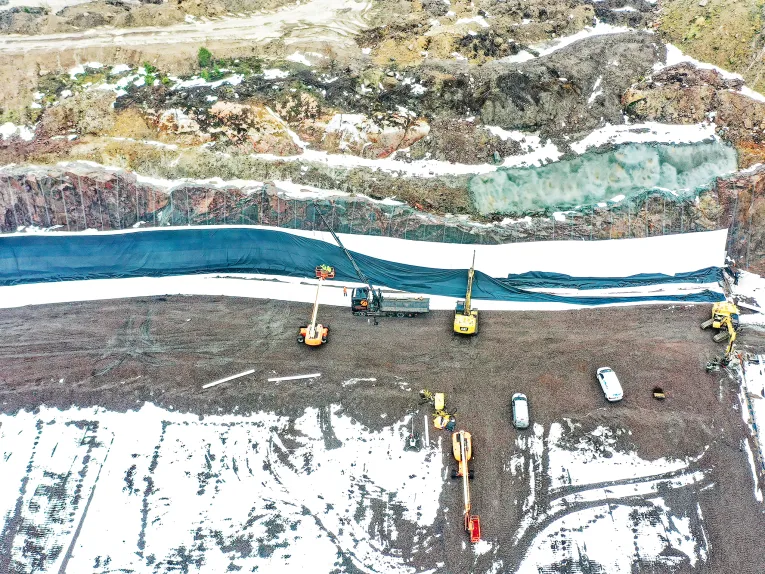
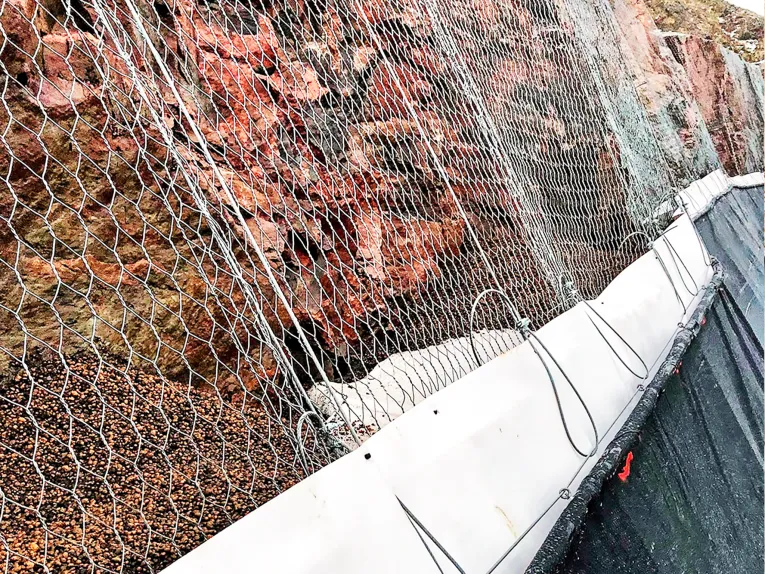
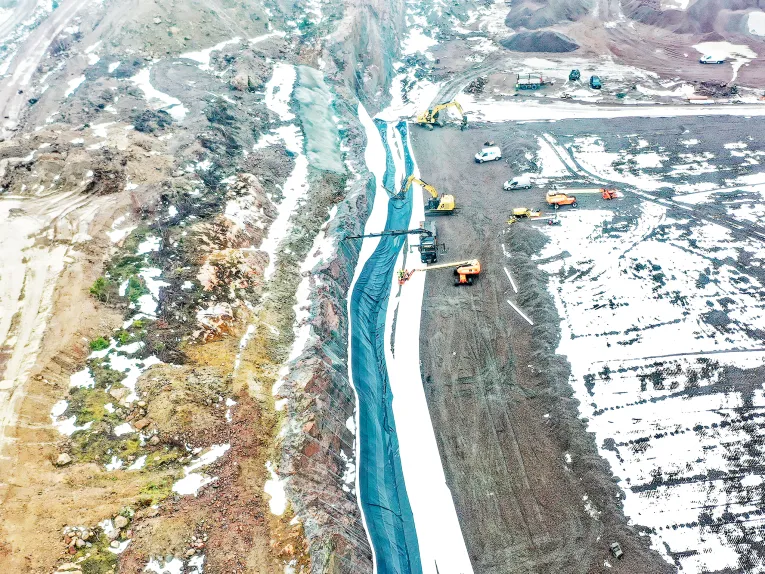
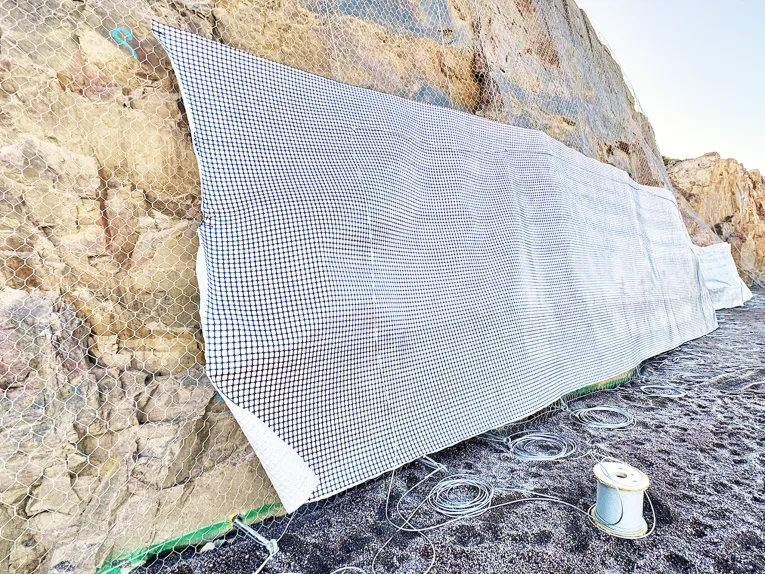
Leca LWA was pneumatically blown directly into the gap. Once in place, it filled the space, following the contours of the rock, remained stable, and created a smooth surface—so the rubber liner was no longer at risk of tearing.
“When we filled behind the structure with the LWA, the result was like a huge beanbag against the rock! No sharp edges—it was completely smooth. Like a big bag, but six meters high and reinforced,” says Rikard.
Using Leca LWA also reduced the amount of fill material needed. A concrete layer would have required a three-meter thickness at the base and up to six meters at the top. With the Leca solution, the liner could be anchored closer to the rock wall - creating 15% more volume in the landfill cell than originally planned.
A lightweight solution built to last
The lightweight aggregate structure currently rises six meters up the rock wall. The landfill will be filled gradually. Once the waste reaches six meters, another six meters of containment structure will be added, continuing until the cell is full.
“We considered using sand instead. It might have been cheaper, but because sand is heavier, we could only have built one meter at a time. That would mean alternating layers of waste and sand, meter by meter. Since Leca LWA is lighter, we could build six meters at once, which made the process far more efficient,” Rikard explains.
Companies willing to innovate together
The containment system was completely custom-designed and made possible by bold clients, innovative contractors, and strong collaboration.
“This was a unique type of construction, but Ragn-Sells was an exceptionally brave client, willing to think outside the box. Their focus on sustainability was very clear.”
The companies involved included Firma Terra, responsible for rock stabilization and securing the structure; Gnesta Bergbyggare AB as contractor; and Structor, who designed the containment system. Rikard highlights the teamwork as a key success factor:
“Most collaborations work well, but this was something special. The contractor was fantastic at getting things done and making sure everything was right. When you do something no one has done before, you need the right people around you—and we had that on this project.”
Downloads