FINNINGLEY AND ROSSINGTON REGENERATION ROUTE SCHEME (FARRRS)
Project Overview
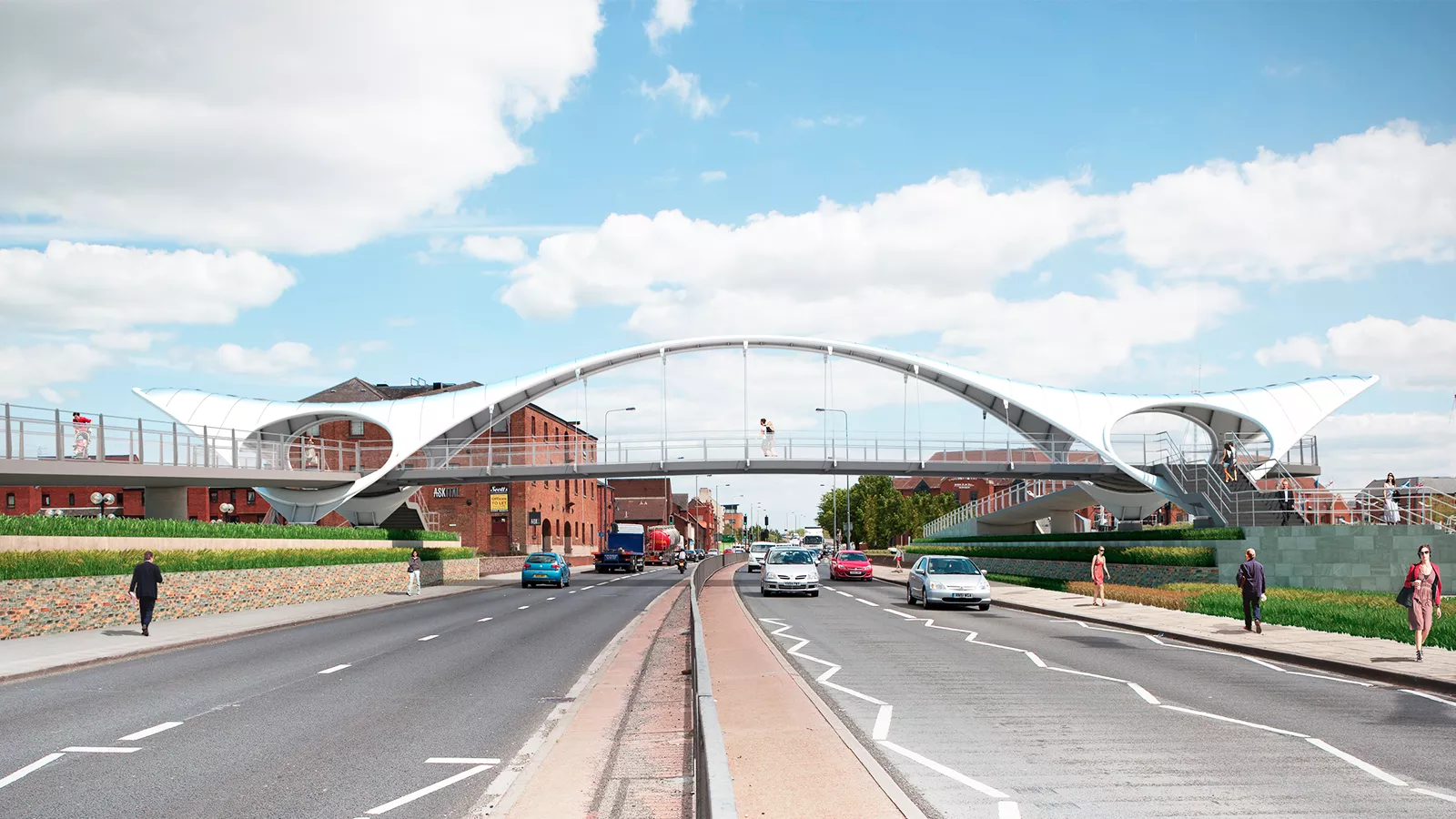
The Finningley and Rossington Regeneration Route Scheme (FARRRS) formed part of Doncaster Council's £32 million highway infrastructure programme, delivering a strategic link between the M18, Robin Hood Airport (now Doncaster Sheffield Airport) and the iPort logistics hub. The project included several bridge structures requiring lightweight approach embankments constructed over challenging ground conditions.
Originally specified with expanded polystyrene (EPS) fill, the design team sought a proven alternative that offered greater supply reliability, simplified construction and long-term engineering performance. Leca® Lightweight Expanded Clay Aggregate (LWA) was selected as the preferred lightweight fill solution.
Engineering Challenge
The bridge approach embankments required a lightweight structural fill capable of:
- Minimising differential settlement adjacent to piled bridge abutments
- Reducing vertical and lateral loading on weak subgrades
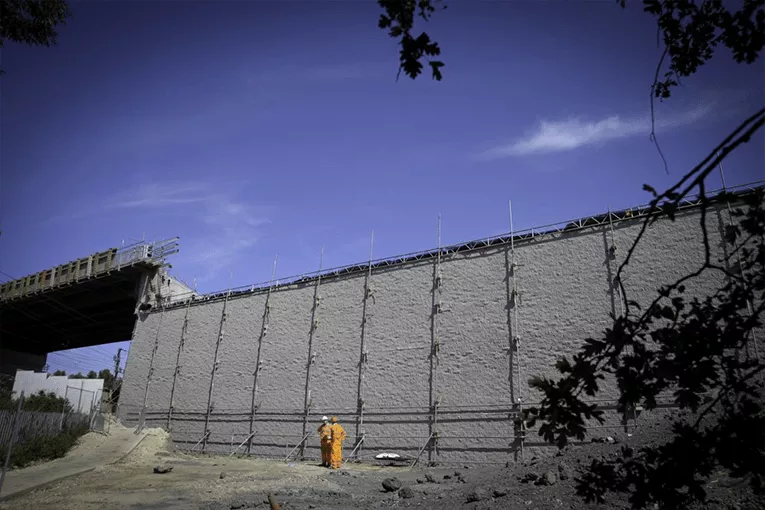
- Providing compatibility with reinforced soil wall construction
- Accelerating construction while maintaining long-term structural performance
- Supporting a sustainable, lower-carbon infrastructure solution
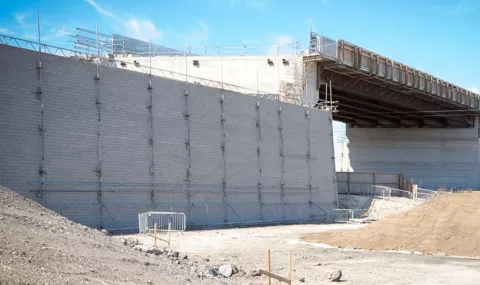
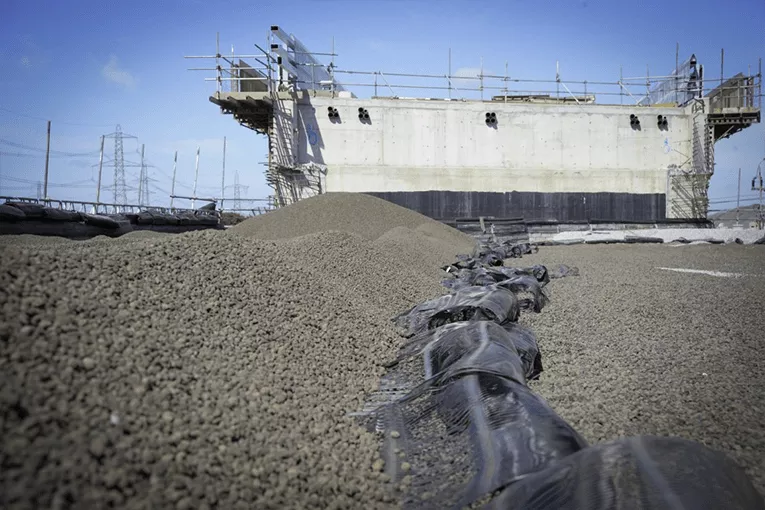
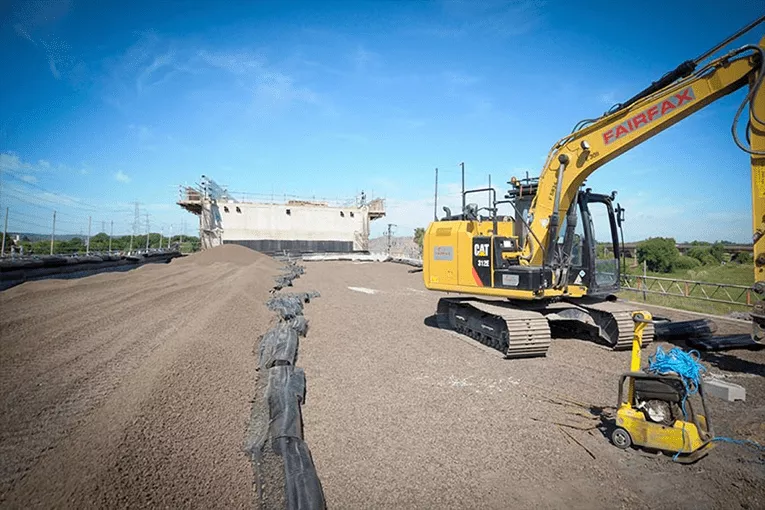
More than 26,000m³ of Leca® LWA was supplied in bulk and incorporated into the reinforced embankments using a geogrid-reinforced retaining wall system.
FACTS
Amount of material: 26,000m3 Leca (10-20mm) LWA
Interesting Fact: The original design proposed use of expanded polystyrene to deliver a low weight of high volume infill against the abutments but the limited experience of this design, coupled with the evident limited capacity of supply, forced the developers to seek a suitable, proven and available alternative.
Delivery Method: 4-Wheel Tippers
Client: Doncaster Council
Designer: Mott MacDonald
Why Leca® LWA?
Leca LWA provides approximately 75% lower unit weight than conventional granular fill while maintaining excellent shear strength and drainage characteristics. Recent UK infrastructure research demonstrates that lightweight aggregate significantly reduces earth pressures acting on retaining structures and bridge approaches, making it particularly effective where poor ground conditions or settlement-sensitive structures exist.
Key engineering benefits include:
- Approximately 75% reduction in fill weight compared with conventional earthworks
- Reduced vertical and lateral earth pressures
- Lower differential settlement at bridge transitions
- Reduced load demand on piled foundations and load transfer platforms
- Excellent compatibility with geogrid reinforced soil systems
- Free-draining, durable and non-degradable fill
- Reduced embodied carbon compared with conventional structural solutions
- Reinforced Soil Wall Performance
The reinforced embankments utilised Leca® LWA in combination with geogrid reinforcement to create a stable reinforced soil structure.
Compared with conventional fill, lightweight aggregate can:
| Conventional Fill | Leca® LWA |
|---|---|
| Higher vertical loading | Approximately 75% lower self-weight |
| Greater settlement potential | Reduced settlement risk |
| Higher earth pressures | Lower lateral loading |
| Greater pile demand | Reduced foundation loading |
| Higher embodied carbon | Lower carbon structural solution |
Recent UK design studies have shown that using lightweight aggregate within reinforced soil walls can:
- Reduce tensile forces within reinforcement layers compared with conventional fill
- Reduce foundation loading and pile demand
- Improve long-term serviceability by limiting post-construction settlement
- Deliver structures designed for a 120-year design life in accordance with BS8006 principles.
Where conventional embankments generate high surcharge loads on weak soils, lightweight aggregate enables engineers to optimise foundation and retaining wall design while maintaining structural stability.
Construction Benefits
The FARRRS project also demonstrated significant construction advantages.
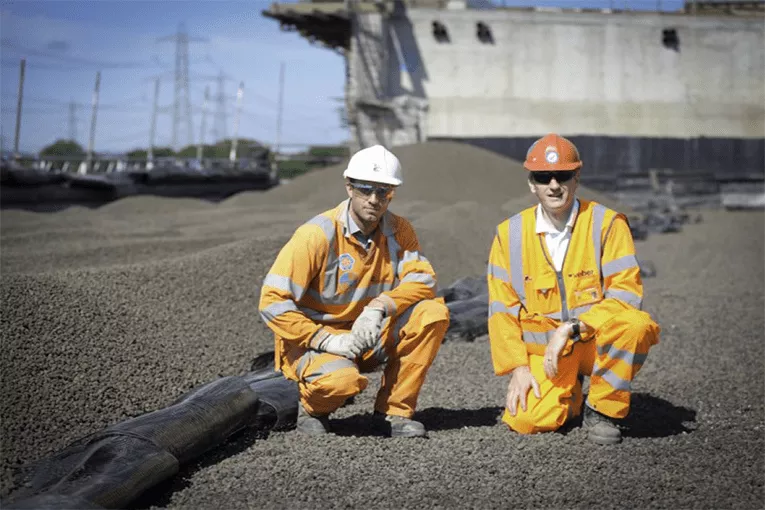
Bulk deliveries using walking-floor vehicles allowed safe, efficient placement directly adjacent to the works, while Leca LWA was installed in 450 mm layers to integrate with the reinforced soil wall construction sequence and Tensar geogrid system.
The lightweight material proved straightforward to handle on site, reducing plant effort and simplifying placement compared with heavier conventional fills.
A Proven Lightweight Alternative
Recent UK research into reinforced bridge approach structures has reinforced many of the engineering principles successfully demonstrated at FARRRS. Studies show that lightweight aggregate can:
- Reduce pile requirements by up to 40% on comparable bridge approach schemes through lower imposed loads.
- Deliver material carbon savings exceeding 50% compared with reinforced concrete retaining wall alternatives, alongside reductions in programme and construction activities.
These findings further support the use of Leca LWA as a practical, proven solution for bridge approaches, reinforced soil walls and infrastructure projects constructed over weak or compressible ground.
Contractor Feedback
“Leca LWA played a key part in this construction project,” says Mike Widdicks, Carillion’s Project Manager. “A project of this size and complexity requires close co-ordination between the main contractor, the designers, the supply chain and Network Rail. There was concern on the cost, the supply and risks of the initial product specification but the Leca LWA material enabled us to maintain the original envelop of the bridge design, saving time delays for the whole project.”
Dave Finn, one of Carillion’s site team who lives locally, is proud of his work on the project. “My kids believe I’ve built the new bridges single handed of course! But in years to come I’ll look back on this job with pride. This Leca LWA is very good indeed and really easy to handle. Nothing else would give you 450mm layers as fast as this.”
Related Downloads
 preview
 preview
 preview
 preview
 preview
 preview
 preview
 preview
 preview